
What a Government Shutdown Means for the Housing Market
Written by Graham Team · Graham Team Real Estate Advisors — Henderson & Las Vegas, NV · Contact
Dated: November 10 2025
Overview: While the phrase “government shutdown” might sound alarming, the housing market doesn’t actually come to a standstill. Homes still sell, buyers still close, and agents keep deals moving, though some federally backed loans and flood insurance approvals may experience short delays. In this article, we break down what really happens during a shutdown, how past markets responded, and what it means for today’s buyers and sellers.
There’s been plenty of buzz lately about how a government shutdown might affect the housing market. So, does everything come to a screeching halt?
The short answer: no.
The housing market doesn’t stop, it adjusts. Homes are still bought and sold, contracts continue to be signed, and closings move forward. While some steps in the process may slow down slightly, overall, real estate activity continues.
Here’s What Typically Happens
During a government shutdown, certain federal agencies reduce or pause their operations, which can create a few bottlenecks in real estate—especially for government-backed loans and insurance approvals.
– "Applicants for FHA, VA, or USDA loans, which account for about one-quarter of all mortgage applications, may encounter significant processing delays due to agency furloughs.” – Selma Hepp, Chief Economist at CoreLogic
– "By recent estimates, more than 2,500 mortgage originations per working day are at risk of delays during a shutdown…” – Zillow
– "Flood insurance approvals may also pause. The National Flood Insurance Program can be temporarily disrupted, delaying closings in flood-zone areas.
Even with those hurdles, most transactions still move forward. Buyers continue buying, sellers keep listing, and agents stay busy helping clients navigate the process.
The Market Usually Bounces Back Quickly
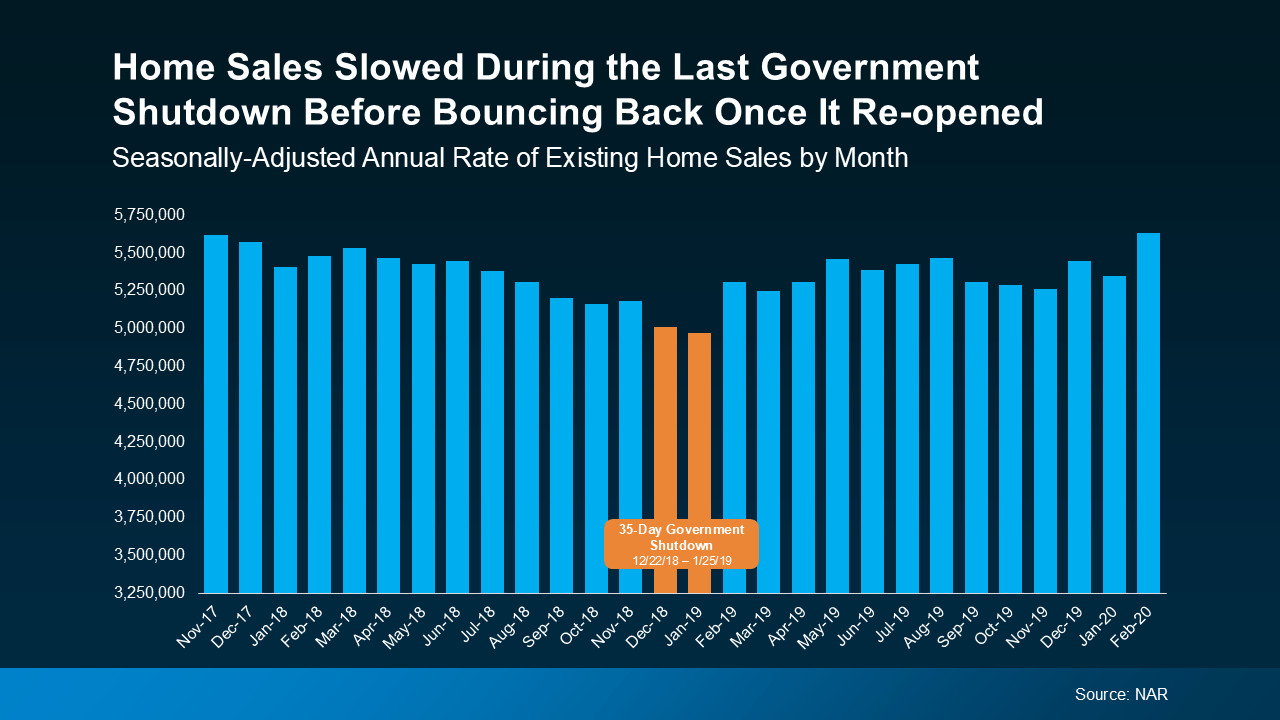
History shows these slowdowns are temporary. Take the most recent government shutdown at the end of 2018, which lasted 35 days. Home sales dipped slightly during the closure but recovered quickly once operations resumed.
Data from the National Association of Realtors (NAR) reveals existing home sales slowed for about two months and then surged back as delayed closings caught up once the government reopened.
The brief dip in activity wasn’t a normal seasonal lull. It aligned directly with the shutdown. Once the government was back in business, the housing market snapped right back, showing how resilient it really is.
What This Means for Buyers and Sellers
If you’re currently under contract or about to close, don’t stress. Most deals still go through, even if timelines stretch a bit. As Jeff Ostrowski, Housing Market Analyst at Bankrate, explains:
“If you’re expecting to close in a week or a month, there could be some slight delay, but I think for most people, it’s probably going to be a blip more than a real deal killer.”
And if you’re just starting your home search or thinking about listing, this might actually work to your advantage. Some buyers and sellers hit pause during uncertain times, creating a short-lived window of opportunity.
With fewer people actively competing, prepared buyers may find better deals, and motivated sellers might be more open to negotiation. These small market lulls can offer a strategic chance to make your move before activity ramps back up again.
Bottom Line
A government shutdown can cause short-term delays, especially for certain loan types, but it doesn’t derail the housing market. The last time this happened, sales rebounded the moment federal operations resumed.
If you’re wondering how current events might affect your plans or whether now’s the right time to buy or sell, let’s connect. We can walk through your options and create a smart game plan to move forward with confidence.
Graham Team Real Estate • (702) 930-9551 • Team@grahamteamnv.com
Instagram | Facebook | YouTube | LinkedIn | TikTok
3007 W Horizon Ridge Pkwy, Ste. 210, Henderson, NV 89052
Frequently asked questions
Will a government shutdown stop me from buying a home?▾
No, a government shutdown will not stop you from buying a home. General real estate transactions and conventional private mortgages continue to move forward. However, buyers utilizing federally backed loans or those requiring flood insurance in designated zones may experience processing delays during the shutdown.
How does a government shutdown affect FHA, VA, and USDA loans?▾
A government shutdown causes federal agency furloughs, leading to processing delays for FHA, VA, and USDA loans. While FHA and VA loans usually continue to close with delays, USDA loan processing typically pauses entirely because the Department of Agriculture closes, halting new loan approvals until operations resume.
Can I get flood insurance during a government shutdown?▾
It depends on the policy provider. The National Flood Insurance Program (NFIP) can experience temporary disruptions during a government shutdown. If your new home is in a high-risk flood zone requiring NFIP coverage, these administrative pauses can delay your closing until the government reopens.
How does a government shutdown impact mortgage interest rates?▾
A government shutdown does not directly determine mortgage rates, but the surrounding economic uncertainty can influence them. Investors often seek safer assets like U.S. Treasuries during federal disruptions, which can sometimes cause mortgage interest rates to dip slightly in the short term.
How long does it take for the housing market to recover after a shutdown?▾
Historically, the government shutdown housing market impact is short-lived. During the 35-day shutdown in 2018, home sales slowed for about two months but recovered rapidly. The market typically bounces back quickly as delayed closings catch up once federal agencies reopen and resume normal operations.
Can I still lock in my mortgage rate during a government shutdown?▾
Yes, you can still lock in your mortgage rate during a government shutdown. Private lenders operate independently of federal funding and continue to lock rates and process conventional loans. However, check with your lender to ensure your loan doesn't require federal verifications that could cause delays.